Transform your dog's health
Healthy skin, better digestion, more energy.
See why thousands of Australian pet parents switched to raw food and never looked back.

In 2023, we surveyed Big Dog Pet Foods’ customers, and these were some of the results they experienced after switching their dog to a raw food diet:
How a raw diet can improve your pet's life
As raw feeding is the most natural option for pets, it makes sense that this style of feeding will be full of health benefits for them.
Some of the benefits of raw feeding include:
- • A stronger immune system
- • Improved cardiovascular health
- • Better gut health
- • Reduced risk of chronic disease
- • Improved skin and softer, shinier coat
- • Superior joint and bone health
- • Decreased incidence of obesity
Testimonials



Frequently Asked Questions
Whether you’re just starting your raw feeding journey or looking to make the switch to a more natural diet, we’ve got all your questions covered.
Can I feed my puppy Big Dog?
Yes.
If your puppy was weaned onto a raw food diet, you can generally transition straight to a 100% Big Dog diet. You can start them on any flavour from our core range (Beef, Chicken, Combo, Tasmanian Salmon, and Lamb.). Most people choose Chicken as it is highly palatable, especially when starting off on raw food for the first time. Alternatively, our Combo for Small Dogs diet may be most suitable for smaller pups. Our Small Dogs recipes are minced more finely and is portioned into smaller sizes, which can help reduce wastage in the transition phase or in smaller breeds. Our recipes for small dogs that are suitable for puppies are Combo, Beef, and Sensitive Skin.
Please be aware that our food will last about 2 days in the fridge once defrosted.
If your pup was weaned onto cooked or processed food (canned food, dry food or cooked rolls) then we recommend to introduce our food slowly. A raw food diet is very different to a processed cooked diet and any sudden change of diet can create stomach upsets and gradually transitioning helps to minimise this.
Please follow these guidelines, whilst monitoring your puppy’s stools. Loose stools are OK during the transitioning period, but do make sure there is no persistent, watery stools.
Day 1-3: 20% New Diet 80% Old Diet
Day 4-6: 40% New Diet 60% Old Diet
Day 7-9: 60% New Diet 40% Old Diet
Day 10-12: 80% New Diet 20% Old Diet
Day 12+: 100% New Diet
Just keep an eye on their weight to make sure you’ve got the feeding amount right – you’ll find our guide on our boxes and on each product page. This is a great starting point for feeding. Keep in mind that feeding guides are general and optimal feeding amounts may vary with age, size, breed, and activity level. Increase or decrease the amount your pup consumes daily to ensure a healthy weight is maintained.
A Guide To Raw Feeding Your Puppy
How do I transition my pet to your raw food?
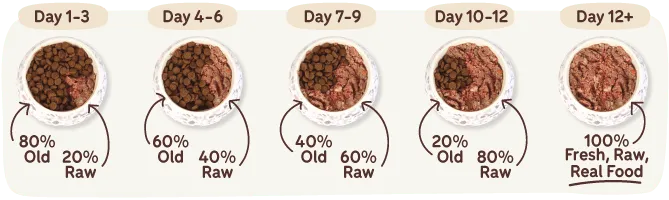
We always recommend slowly introducing raw diets over 2 weeks. The reason for this is to minimise any potential for stomach upsets which can happen if a change in diet is sudden. Some pets will have no issues with a quick changeover in diet, however to be sure, we do recommend slowly introducing the new food.
Day 1-3: 20% New 80% Old
Day 4-6: 40% New 60% Old
Day 7-9: 60% New 40% Old
Day 10-12: 80% New 20% Old
Day 12+: 100% New Diet
Remember, there are no preservatives in our food so it will last only 2-3 days in the fridge once defrosted.
Can I mix kibble and raw together?
Yes! You absolutely can co-feed kibble and raw. In fact, if your dog was on a kibble diet beforehand, mixing kibble and raw is how we recommend they transition over 10 - 12 days. This helps to ensure they have time to get used to the introduction of raw food into their diet. If you wanted to read more about transitioning your pet, read this.
We believe that any inclusion of raw food into your pets diet will benefit them however, if you’d prefer to feed a mixture of diets on an on-going basis, also known as co-feeding, ensure to adjust the feeding portions to reflect this.
For example if you choose to split your pet’s diet into 50% of a Big Dog diet and 50% of another diet, we advise to only feed half the recommended feeding portion for each diet.
For dogs and cats that have more sensitive stomachs, their diet can still consist of a raw diet and a kibble diet however if you notice any issues it could be advised to feed these two diets at different time, for example feed raw in the morning and their other diet at night, or vice-versa.
What is a raw food diet?
Raw food diets by definition are diets comprised of nothing but raw food. These can take many forms and the most popular of these is a BARF diet. BARF stands for biologically appropriate raw food or bones and raw food. This dietary model is based on the evolutionary diet animals would have eaten in the wild. Evolutionary raw diets are made up of fresh raw meat, offal, crushed meaty bones, vegetables, fruits and other healthy ingredients.
For more information on a Raw food diet for dogs – visit, “Evolution for dogs and a species appropriate diet”
Raw food diets are different for dogs and cats as they have different and unique dietary requirements.
All Big Dog raw diets are 100% natural, no synthetic vitamins and minerals, artificial chemicals, colours, flavours or preservatives are present. All Big Dog diets are raw and uncooked to best preserve the quality and nutritional value of the proteins.
Check out the Big Dog product range for dogs and cats here.
How long does a patty last? How long can I store it for?
Our patties are safe to use up to their expiry date as long as they have been correctly stored and frozen for the whole duration. After thawing the patty, we recommend they be kept in a sealed, airtight container in the fridge, and used within 2 - 3 days. Discard any thawed product that no longer looks or smells fresh. If you have a small dog and find our patties are too big for you to get through in time, check out our Big Dog for Small Dogs Combo, Big Dog for Small Dogs Beef, Big Dog for Small Dogs Kanga, Big Dog for Small Dogs Sensitive Skin.
Can I cook your food?
No. Our dog recipes contain crushed real bone. Not only does cooking change the nutritional value of the fresh healthy ingredients, cooking bone results in it becoming brittle, potentially splintering and should not be ingested by your dog in this state.
The exception to this is our Nourish Nutrition and cat recipes. While we recommend feeding them raw, it is safe to lightly cook these recipes, if necessary as they do not contain crushed bone.
Do your products contain preservatives?
Absolutely not, at Big Dog, when we say 100% natural we mean 100% natural. This means no added preservatives, no modern preservation methods like irradiation which impact the nutritional quality of the food nor do we add any synthetic additives such as vitamins and minerals, colours or flavours.
Our preservation method for our food is freezing and once our product has been thawed, it will last 2-3 days when kept in the fridge.
Whilst our food may last longer than 3 days, be sure to keep an eye out for signs of deterioration of the product like ballooning of the packaging. If this occurs, do not serve your pet and dispose of the product.
